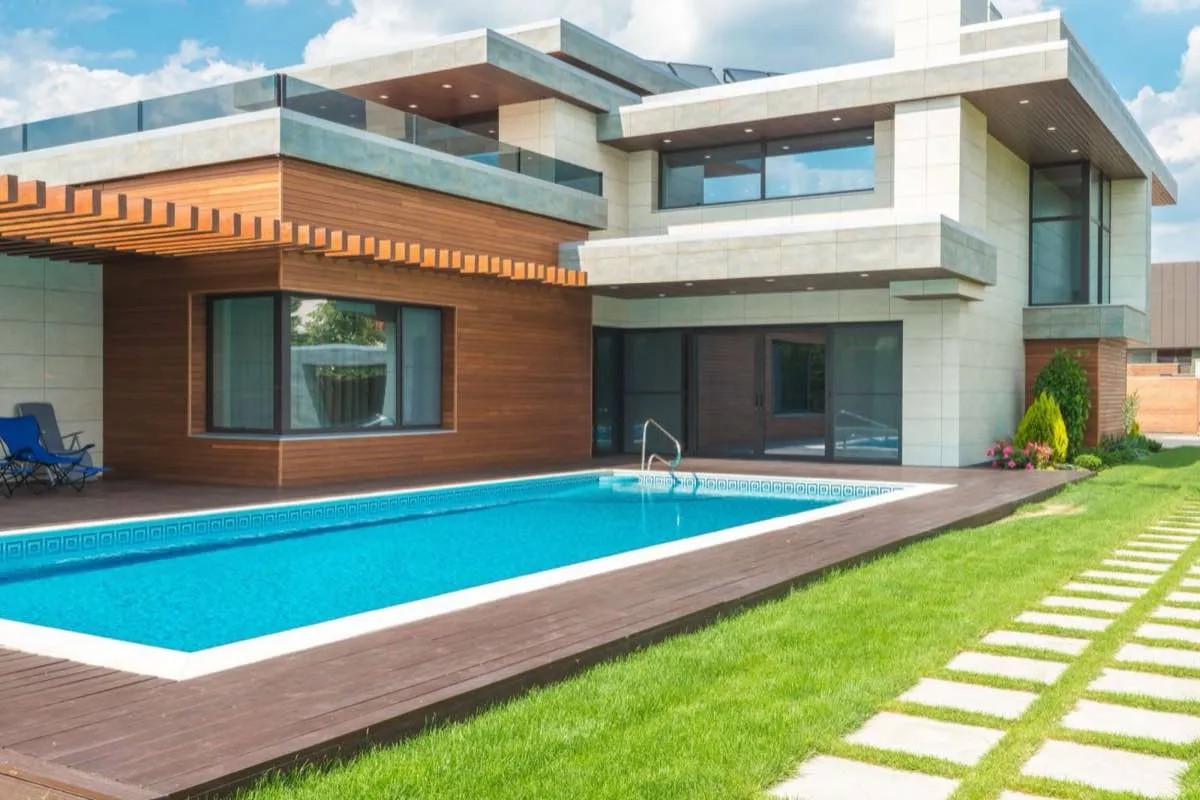
Short version on above ground vs inground pool: an above-ground pool costs $2,500 to $9,000 installed and lasts 10 to 20 years. An inground pool costs $45,000 to $85,000 and lasts a lifetime with resurfacing. Both hold water at the same temperature. The difference is permanence, depth, and what your yard looks like the day you sell.
There is a lot of snobbery in this conversation, and most of it is nonsense. Plenty of families have had a fantastic decade around a $4,000 above-ground pool. Plenty of people have spent $70,000 on a gunite pool they swim in six times a year. The right answer depends entirely on how you actually live.
The comparison, without the sales gloss
| Above ground | Inground | |
|---|---|---|
| Installed cost | $2,500–$9,000 | $45,000–$85,000+ |
| Install time | 1–3 days | 3–12 weeks |
| Typical depth | 48–54 in, uniform | 3 ft to 8 ft, your choice |
| Diving | No, ever | Only with a properly designed deep end |
| Structure lifespan | 10–20 years | 40+ years with resurfacing |
| Liner / surface replacement | $700–$2,000 every 6–12 yrs | $5,000–$12,000 every 8–20 yrs |
| Effect on appraised value | Generally none | Varies by market, usually positive |
| Reversible | Yes, in a day | Absolutely not |
Where above-ground genuinely wins
Speed. Level ground, a decent kit, two people who read the instructions — the pool is holding water the same weekend. An inground project means excavation, a permit cycle, rebar, plumbing, gunite, cure time, plaster, and a start-up period. Three to twelve weeks of your backyard being a construction site.
Reversibility. This matters more than people admit. If you move in four years, you drain it, unbolt it, and the yard is a yard again. An inground pool is a decision your buyer has to want too.
Cost of being wrong. Some people discover they do not actually swim much. Finding that out for $4,000 is much better than finding it out for $60,000.
Where inground genuinely wins
Depth and shape. Above-ground pools are a uniform 48 to 54 inches. That is fine for a family with young kids and genuinely tiring for an adult who wants to swim laps or a teenager who wants to dive. No above-ground pool is safe to dive into, and no reputable installer will tell you otherwise.
Integration with the yard. An inground pool with proper decking and coping becomes the backyard. An above-ground pool sits in the backyard. That is an aesthetic point, but it is also a resale point.
Longevity. A well-built gunite shell outlives its owner. The finish gets replaced every 8 to 20 years, the equipment every decade, and the pool itself keeps going. If you compare a 40-year horizon, you are looking at two or three above-ground pools against one inground.
The deck trap
Here is where above-ground budgets quietly become inground budgets. A bare above-ground pool with a ladder is $4,000. A wraparound deck to make it feel like a real pool is $3,000 to $12,000 in lumber, framing, and railing — and it needs its own permit and its own footings.
Our honest line: if your above-ground project with decking crosses about $15,000, stop and price an inground pool before you sign. A modest inground pool with a small patio starts closer than people expect, and you end up with something permanent. Our fiberglass versus gunite comparison covers where that money actually goes.
Code, fencing, and the part that is not optional
Whichever you choose, the barrier requirements are real. Jurisdictions following the International Swimming Pool and Spa Code generally require a barrier at least 48 inches high around any pool holding water deeper than 24 inches, with self-closing and self-latching gates and specific limits on climbable surfaces.
An above-ground pool's own wall can count toward that in some jurisdictions if the ladder is removable or lockable. Some jurisdictions. Not all. Ask your building department the specific question before you assume the wall counts, because the follow-up conversation with an inspector after installation is not a fun one.
Also: the pump needs a properly bonded and GFCI-protected circuit. This is the one part of an above-ground install that is not a DIY job, regardless of how handy you are.
When you should not hire anyone
We build inground pools for a living, so take this as it is meant.
A 24-foot round above-ground pool on genuinely flat ground is a real DIY project. Two people, a weekend, a lot of patience with the wall track. You do not need a contractor for it.
The one thing you cannot fudge is level. The base needs to be within about an inch across the whole diameter, and if the ground slopes, do not fix it by building up the low side with dirt. Cut into the high side instead. Water weighs a little over eight pounds a gallon, and 13,500 gallons pushing on a wall that is sitting an inch high on one edge is how a pool wall lets go at two in the morning.
Hire out the electrical, hire out any real grading, and do the rest yourself.
So which one
- Above ground if you are staying under five years, the budget is under $10,000, you have a flat spot, and nobody in the house needs to swim laps or dive.
- Inground if you are staying seven or more years, you want a deep end, you have side-yard access wide enough for equipment, and the pool is meant to be the center of the backyard rather than a feature in it.
- Semi-inground if your yard slopes and you want the inground look at half the money — just be honest with yourself about the retaining wall cost, which is where these projects go over budget.
Brownsville Custom Pool Pros builds and remodels pools across Brownsville and the Rio Grande Valley. If you want a real number instead of a national average, we will walk the yard, check access and grade, and tell you straight if a new pool or a full remodel makes sense for your lot — or if you would be happier spending a fifth as much. Start with our inground pool cost breakdown or call (833) 762-7004.
Get a free quote → · call (833) 762-7004
Ready for a free quote in Brownsville?
Brownsville Custom Pool Pros — free estimate, clear scope, no pressure. Use the form on this page or jump to the homepage quote.
Related services in Brownsville
Brownsville Custom Pool Pros money pages — go straight to the service you need.
- Pool Remodeling & Renovation →
Pool remodeling in Brownsville almost always starts with a shell that is still sound and everything attached to it being finished. A remodel replaces the waterline tile, coping, interior finish, equipment pad, and lighting, and often reshapes how the pool gets used — a tanning ledge cut into the shallow end, a raised spa with a spillover, a swim-up bench, or a bubbler wall along the back.
- Pool Resurfacing & Replastering →
Pool resurfacing and replastering is what a Brownsville pool needs somewhere between year eight and year twelve, when hard fill water and year-round sun leave the plaster chalky, rough enough to skin a heel, and streaked past any amount of brushing. It is not cosmetic maintenance — a failing interior lets water reach the shell, and that is a far more expensive conversation.
- Spa & Hot Tub Installation →
Brownsville Custom Pool Pros builds spas for Gulf humidity, warm nights, and year-round outdoor use on the coastal plain. Spas here run more nights per year than northern markets, so heaters, covers, and jets see real duty.
- New Pool Construction →
New pool construction in Brownsville means a gunite shell: a rebar cage tied on site, concrete shot pneumatically in one continuous placement, and a seven-day water cure before anything touches the interior. It is slower and costlier than dropping a prefabricated shell in a hole, and it is why a properly built gunite pool in the Valley is still holding water when its owner sells the house.
- Vinyl Liner Pools & Liner Replacement →
Vinyl liner replacement is the job most liner pools in the Valley need, and the ones out here — installed through the eighties and nineties — are usually on their second or third. A liner is a wear item: sun, chlorine, and time make the vinyl brittle at the waterline, the pattern fades, the corners slip out of the track, and eventually a seam lets go.
Frequently asked questions
Is an inground pool worth the extra money?
It is if you will be in the house 7 or more years, you want a deep end, and the yard can take it. An above-ground pool costs a fifth as much and swims just fine, but it typically lasts 10 to 20 years, cannot be dived into, and appraisers generally treat it as personal property rather than a permanent improvement.
How much does an above ground pool cost installed?
A 24-foot round steel-wall kit usually lands between $2,500 and $6,000 installed on level ground. Resin and hybrid walls run $4,000 to $9,000. Semi-inground models with retaining walls climb to $8,000 to $20,000, at which point you should price fiberglass before committing.
Do above ground pools need a permit?
Usually yes. Most jurisdictions that follow the International Swimming Pool and Spa Code require a barrier at least 48 inches high for any pool holding water deeper than 24 inches, and many require electrical permitting for the pump circuit. Check with your Brownsville building department before the truck shows up, not after.
How long does an above ground pool last?
Ten to twenty years for the structure, with resin walls outlasting steel in humid or coastal air. The liner is the consumable — plan on replacing it every 6 to 12 years for roughly $700 to $2,000.
Can you convert an above ground pool to inground?
Not really. Semi-inground models are designed to be partially buried and rated for it; a standard above-ground wall is not built to hold back soil and will collapse inward when the pool is drained. If burying it is the goal, buy a pool designed for that from the start.
Which is cheaper to maintain, above ground or inground?
Above ground, mostly because there is less water to treat — a 24-foot round holds around 13,500 gallons versus 20,000 or more for a mid-size inground. Chemistry, pump power, and cleaning routines are otherwise nearly identical.
Local context
How this applies in Brownsville, TX
Every article here is written from pool work done in Brownsville and the Rio Grande Valley, so the numbers reflect local labour, permit and material costs rather than a national average. Your own job can land either side of them depending on access, the condition of what is already there, and the materials you pick — gunite and shotcrete shells, PebbleTec and polished quartz interiors, travertine coping and waterline tile.
The way to turn any of this into a real answer is to have someone look at your actual situation. The free estimate is free, itemized and written down, with no deposit and no obligation. Call (833) 762-7004 or start on the Brownsville Custom Pool Pros homepage.
Areas Brownsville Custom Pool Pros covers
Brownsville first, then the surrounding communities of the Rio Grande Valley. Each has its own page with local detail rather than a copy of this one:
- Harlingen, TX — Cameron County, population 71,900
- San Benito, TX — Cameron County, population 24,860
- Weslaco, TX — Hidalgo County, population 41,100
- Alamo, TX — Hidalgo County, population 19,000
- Donna, TX — Hidalgo County, population 16,800
- Mercedes, TX — Hidalgo County, population 16,260
Or jump to the full list of Brownsville services.
More from the Brownsville Custom Pool Pros blog
- Pool Resurfacing Cost in Brownsville: What to Pay
Pool resurfacing cost in plain English — plaster, pebble, and tile ranges, what drives the price, and when to resurface a pool in Brownsville, TX.
- Saltwater Pool vs Chlorine for Brownsville Pools
Saltwater vs chlorine pools compared on cost, upkeep, and how the water feels — plus which makes sense for a Brownsville, TX pool.
- How to Maintain a Saltwater Pool (Brownsville Guide)
How to maintain a saltwater pool in Brownsville, TX: salt and stabilizer to your cell maker's spec, pH 7.2-7.8, clean the cell every 3 months.
The Brownsville Custom Pool Pros Team
pool specialists serving Brownsville, TX
Written by the Brownsville Custom Pool Pros team — insured pool pros with 15+ years serving Brownsville, TX and the surrounding area.